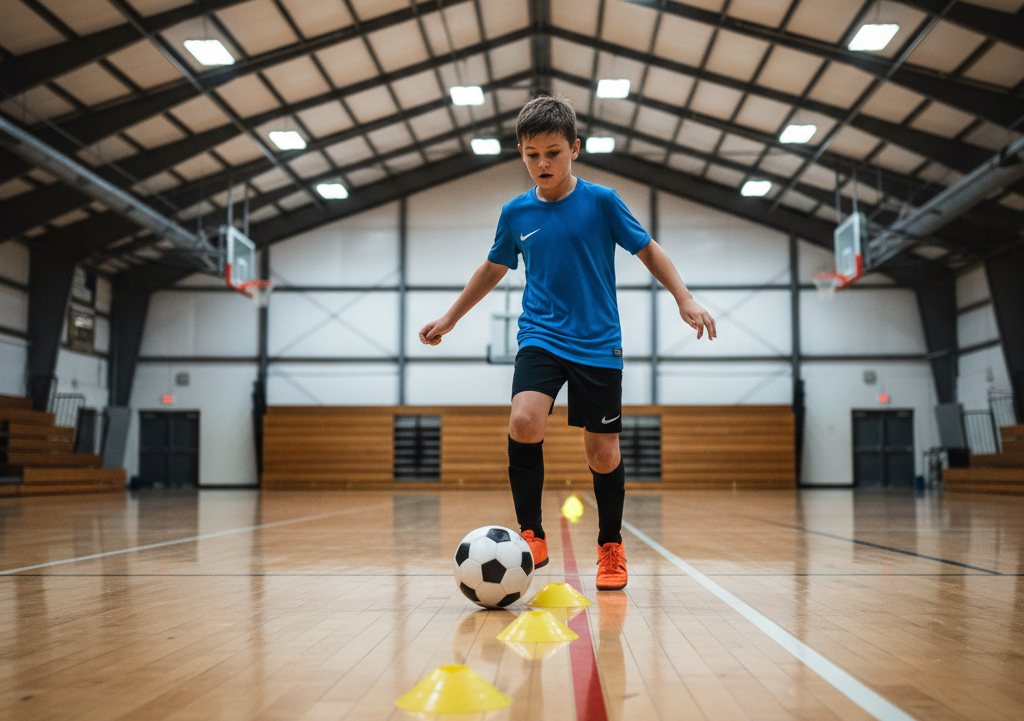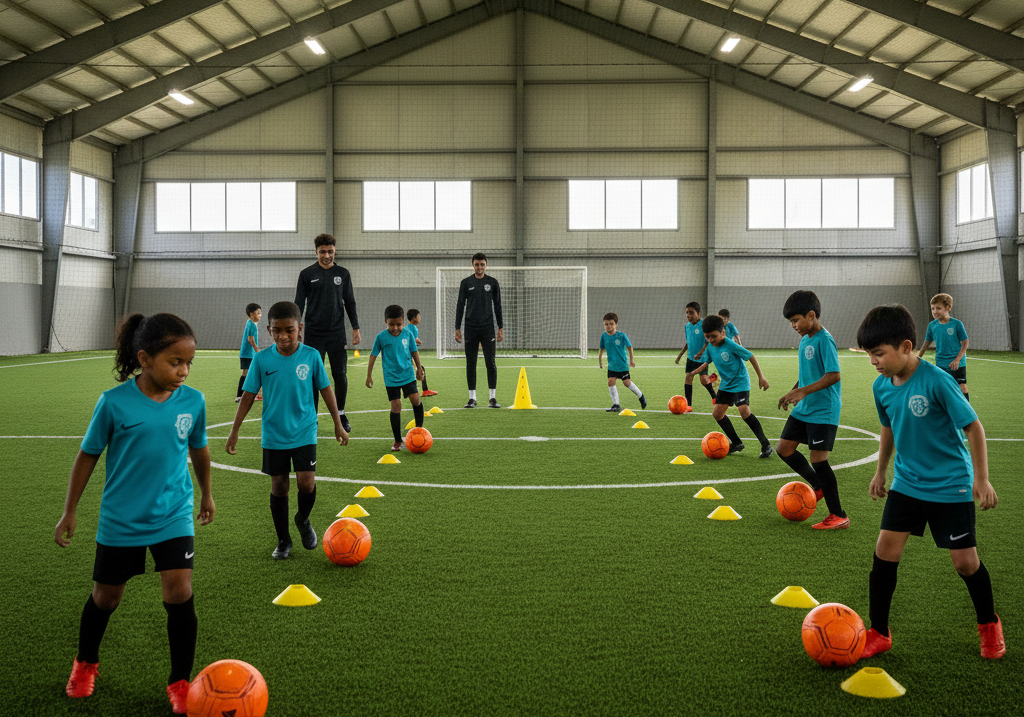

You're watching your seven-year-old at soccer practice, and a familiar knot forms in your stomach. That kid over there is dribbling circles around everyone. Another child just scored three goals in the scrimmage. Your child? Still figuring out which direction to kick.
The question creeps in quietly, then grows louder: Is my child falling behind?
If you've felt this anxiety, you're not alone. It's one of the most common concerns parents express to us at We Make Footballers, though many hesitate to say it out loud. As spring soccer registration opens and teams start forming, parents begin comparing their children to others and wondering if they've somehow missed a critical window.
Here's what you need to know: what looks like "falling behind" is almost always normal development happening exactly as it should. The real danger isn't that your child is behind, it's making decisions based on anxiety rather than understanding how young players actually develop.
Child development doesn't follow a neat timeline. At any given age, children of the same chronological age can vary by up to two years in terms of physical, cognitive, and emotional maturity.
Look at any group of eight-year-olds and you'll immediately see the variation: some tower over their peers, others are noticeably smaller. Some can focus intently for 20 minutes, others struggle to maintain attention for five. Some are naturally coordinated, others are still growing into their bodies.
This variation is completely normal. Yet in youth soccer, we group children by birth year and expect them to develop at identical rates.
Research on youth sports consistently demonstrates something called the relative age effect. Children born earlier in the selection year are statistically overrepresented in elite youth programs, not because they're more talented, but because they're older.
A child born in September playing alongside a child born the following August has up to 11 months of additional development. At age six, that's nearly 20% more life experience. The September child is likely bigger, stronger, more coordinated, and more cognitively mature.
Yet both are labeled "U7" and compared as if they're on equal footing.
When you see another child who seems far ahead of yours, check their birth month. There's a good chance they're simply older.
What's completely normal:
What's actually developing: Basic motor patterns, eye-foot coordination, spatial awareness, and attention span. At this age, research on sport readiness shows children should focus on fundamental movement skills through play, not sport-specific tactics.
What parents worry about unnecessarily:
What's completely normal:
What's actually developing: Refinement of fundamental techniques, beginning tactical understanding, emotional regulation, and longer attention spans.
What actually indicates development:
Research on youth soccer development shows this age is about building technical comfort through high-repetition practice. Children who get hundreds of touches per week in training develop stronger foundations than those who primarily play matches.
This is when development paths genuinely begin to diverge, and when parental anxiety peaks.
What's completely normal:
Here's the critical question at this age:
It's not "Is my child as good as that other child?" It's "Is my child improving compared to six months ago?"
A child showing steady improvement (better first touch, more confidence, improved decision-making) is developing exactly as they should, regardless of where they rank relative to peers.
What genuinely matters:
What doesn't predict future success:
Here's what research consistently shows: the technical skills developed between ages 5-10 largely determine what's possible later.
Children who spend ages 5-10 getting high-quality, high-repetition technical training develop comfort with the ball that serves them at any competitive level. Children who primarily play matches without adequate technical training often plateau around ages 11-13.
This is why "Is my child behind?" often misses the point. The real question is: "Is my child getting the type of training that builds technical proficiency?"
Many recreational programs don't provide these elements consistently. This is where performance gaps emerge, not from innate ability differences, but from training quality differences.
Most developmental variations are completely normal, but certain patterns warrant attention:
This isn't about your child being "behind," it's about needing a better training environment.
Listen to your child. Not every child will love soccer, and forcing participation rarely produces positive outcomes.
How many times per session does your child actually touch the ball? Is coaching focused on skill development or just playing games? Does your child receive individual attention?
If the answers reveal gaps, the issue isn't your child, it's the training environment.
Do they enjoy practice? What's their favorite part? Any anxiety about going?
If they express genuine enjoyment, they're probably developing fine. If they express anxiety or disinterest, something needs to change.
Compare your child to themselves six months ago:
If yes to most of these, they're developing appropriately. Rank relative to other children matters far less than trajectory of improvement.
We understand parental anxiety about development. We also understand that comparing children to each other misses the entire point.
Our approach focuses on three principles:
Every child develops at their own pace. We create environments where each child works on individual development, celebrating personal progress rather than comparing to peers.
Technical foundation is everything. Ages 5-10 are critical for technical skill development. Our sessions maximize ball touches, provide expert coaching, and systematically build skills.
Enjoyment predicts long-term success. Children who love soccer keep playing and improving throughout their lives. We build that love through positive coaching where every child feels capable.
We consistently see children who've lost confidence or plateaued in other programs rediscover their potential within weeks. Not because we magically accelerate development, but because we provide training environments where natural development can actually occur.
Here's the truth: at ages 5-10, there is no "behind."
There are children developing at different rates, with different opportunities and training environments. There are children whose birthdays give them temporary advantages. There are children whose learning styles mesh better with certain coaching approaches.
But "behind" implies a fixed standard where falling back means permanent disadvantage. That's not how child development works.
Your child needs quality technical training, positive coaching, opportunities to play, permission to develop at their own pace, and your belief in their potential.
If those elements are in place, your child is exactly where they should be.
Book a free session at your nearest We Make Footballers location and see how the right training environment helps children develop confidence, skill, and genuine love for the game, at their own perfect pace.
Because the only child your child needs to be better than is the one they were yesterday.

Soccer coaching for children aged 4-12 years old in the US.


We Make Footballers USA LLC